History of Computers
The history of automatic data
processing begins with Charles Babbage’s attempt to build an automatic
mechanical calculator at Cambridge, England, in 1830. In 1930’s punched cards
were in wide use in large businesses. In 1937 Howard Aiken, at Harwad, proposed
IBM that a machine could be constructed to automatically sequence the
operations and calculations performed. This machine used combination of
electromechanical devices, including relays (mercury delay lines)
First
Generation Computers
Ø UNIVAC (Universal Automatic Computer) marks the beginning of the first
generation of electrical computers.
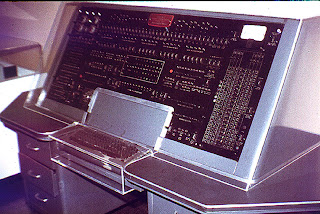 ß(UNIVAC)
Ø 1st generation computers employed vacuum tubes.
Ø The input & output were punched card reader and the card punches.
Ø IBM-650 was the most popular 1st generation computer and was
introduced in 1950 with magnetic drum memory punched cards for input &
output.
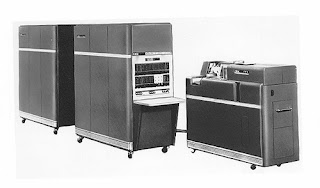 ß(IBM-650)
Ø It was intended for both business & scientific applications.
Second Generation computers
Ø These computers employed germanium transistors & other solid state
devices.
Ø Their circuits were smaller than the vacuum tubes, & generated less
heat.
Ø 2nd generation computers required less power, were faster and
more reliable.
Ø IBM 1401 was the most popular second generation computer.
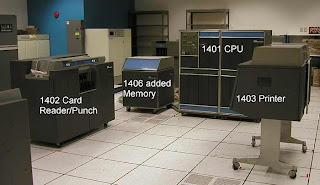 ß(IBM 1401)
Ø They employed magnetic tape as input/output media.


